
- November 13, 2026
- No Comments
Why Do Gout Attacks Keep Coming Back?
Written by Dr Nilesh Nolkha, MD, DM (Rheumatology) | MMC Reg. No. 2008/04/1779 | Nirjara Multispeciality Clinic, Kandivali West and Vasai West, Mumbai
Quick Answer
Gout attacks come back, and come more often, when uric acid stays above 6 mg/dl. Between attacks you feel fine, but uric acid keeps settling into your joints. Painkillers calm the attack; they don’t remove the uric acid. Keeping uric acid below 6 with regular medicine is what stops the attacks.
Key points
- An attack settling down does not mean the gout has gone.
- Uric-acid-lowering medicine is usually lifelong. Stopping it is the most common reason attacks return.
- Diet alone rarely brings uric acid down enough.
- Uric acid can read normal during an attack. That does not rule out gout.

Watch: Dr Nilesh Nolkha explains how gout progresses and why attacks keep returning (Hindi, 6 min).
In this video: 0:00 “Earlier I got one attack a year, now many” · 0:51 What “natural progression” of gout means · 1:38 The first attack and the silent phase · 2:06 Why attacks become frequent · 2:59 Chronic gout and tophi · 3:32 Mistake 1: stopping medicine · 3:56 Mistake 2: checking uric acid during an attack · 4:24 What to do if your attacks are increasing · 5:23 Summary
Isn't gout just about what I eat?
No. For most people, gout is mainly about genes and how the kidneys clear uric acid. Food plays a smaller part than most people think.
In a large analysis of over 16,000 adults, inherited genes explained about a quarter of the differences in uric acid between people. Diet explained less than 1%. That study was in American adults of European origin; we don’t have similar Indian data yet, but what we see in clinic fits it.
This is why many patients stop dal, tomatoes and palak ‘to be safe’, and still get attacks. It also explains why a slim, careful eater can have gout while his heavier friend doesn’t.
How does gout progress if it isn't treated properly?
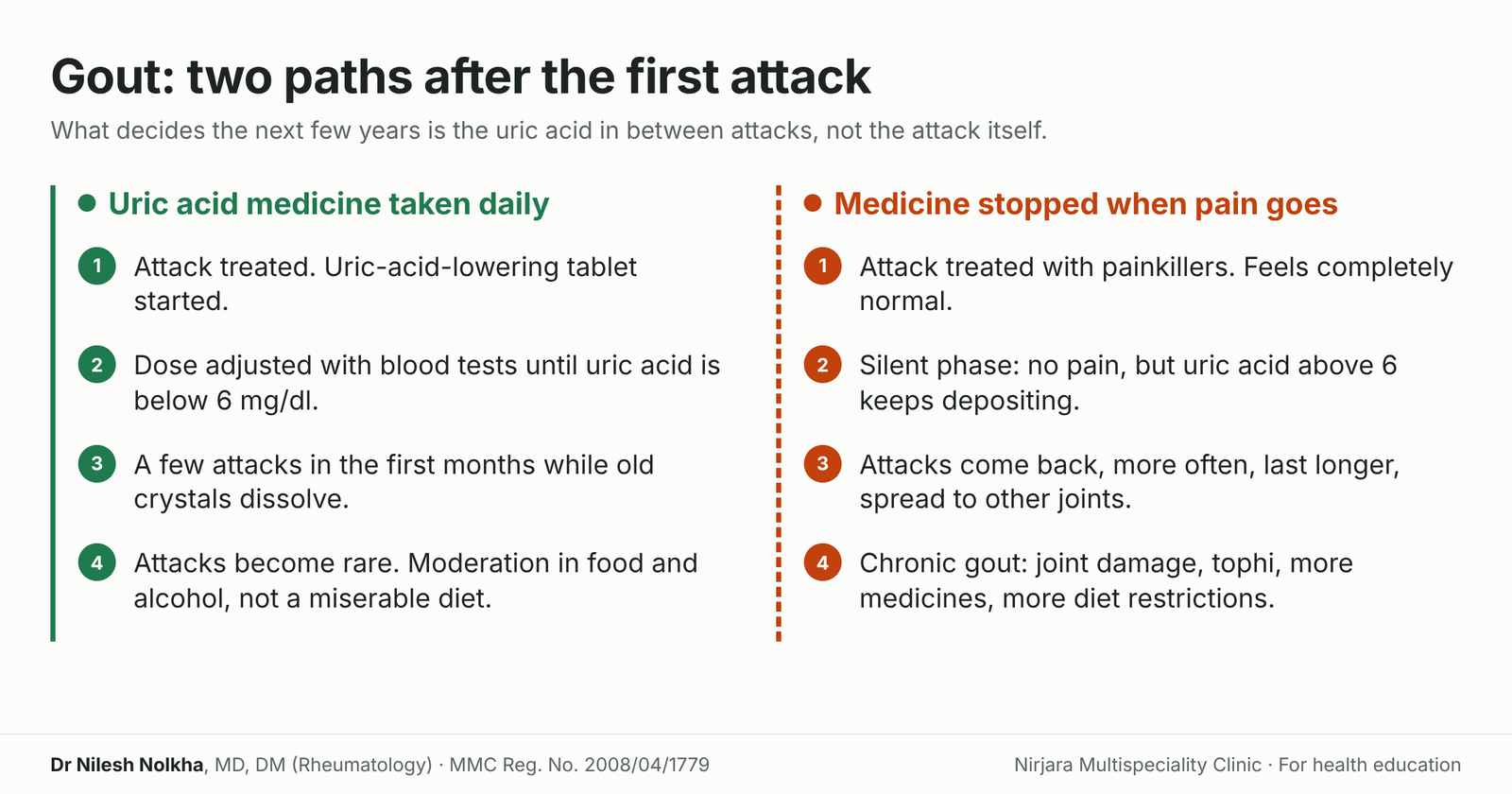
In stages. First, occasional attacks. Then a silent phase where uric acid keeps building up. Then attacks become frequent, longer and spread to other joints. Finally, chronic gout, with joint damage and lumps called tophi.
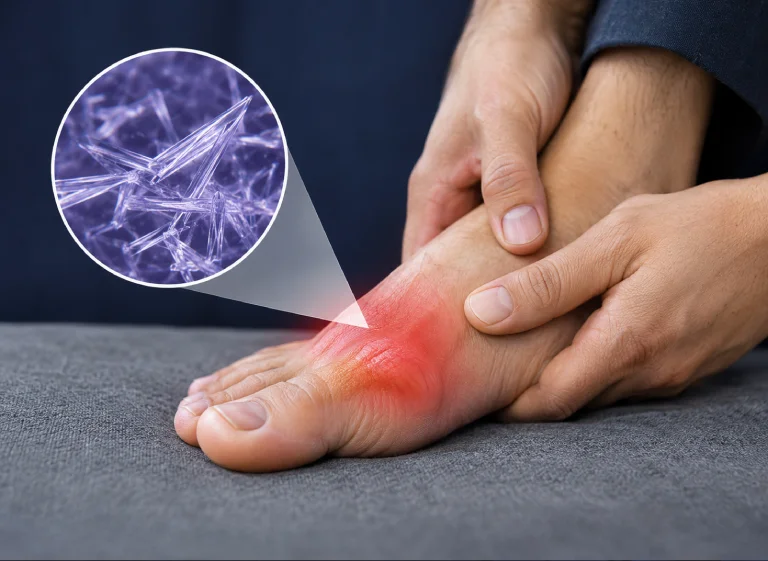
Stage 1: The first attack. Usually the big toe, sometimes the ankle or knee. Sudden pain, swelling, redness. You take painkillers for a few days, it settles, and you feel completely normal.
Stage 2: The silent phase. No pain, no swelling. But if uric acid is above 6, crystals keep depositing in and around the joints. Most people stop all medicine here because they feel fine.
Stage 3: Attacks become frequent. The second attack may come after two months or two years. Then they come closer: once a year becomes three, four, eight times a year. Each attack lasts longer, and other joints start getting involved.
Stage 4: Chronic gout. By now there is so much uric acid in the body that the joints get damaged. Pain doesn’t settle completely between attacks. Chalky lumps called tophi can form near joints, on the fingers, elbows or ears.
The two paths look like this:
| What should happen | What usually happens |
|---|---|
| Attack treated, uric-acid-lowering medicine started | Attack treated, patient wants ‘natural’ treatment |
| Medicine taken daily, dose adjusted till uric acid is below 6 | Medicine stopped once the pain goes |
| Moderation in alcohol and meat; no need to stop them completely | Silent phase: feels the ‘natural’ way is working |
| No or very few attacks | Attacks return, more often, more joints |
| One medicine, usually at a moderate dose, for life | Chronic gout: many medicines, higher doses, many diet restrictions, still getting attacks |
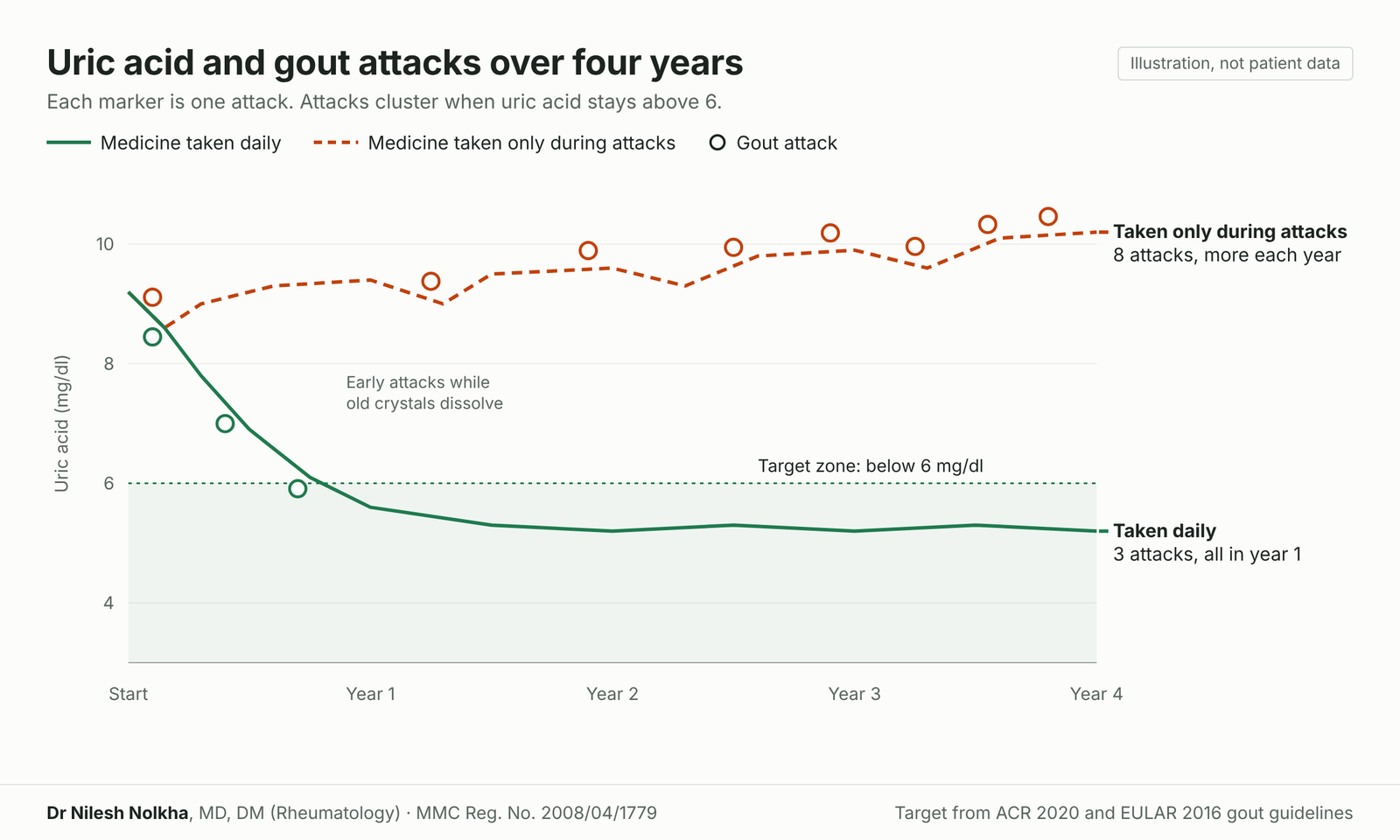
Illustration, not patient data. Attacks cluster when uric acid stays above 6.
Why do my attacks keep coming back?
Usually because uric acid is not being kept below 6 all the time. Four common reasons are behind this.
1. You stop the medicine when you feel fine. This is the biggest one. The tablet only works while you take it. Stop it, and uric acid rises again within weeks.
2. You are relying on diet alone. Even a strict diet usually lowers uric acid by about 1 point, and the effect tends to fade after a few months. Most gout patients need a drop of 2 to 4 points. Diet helps; it can’t do the job alone.
3. You checked uric acid during an attack, and it was ‘normal’. Uric acid often falls during an attack. In one large study, about 1 in 7 people had uric acid of 6 or below in the middle of an attack. So a normal report during an attack does not mean you don’t have gout, or that your gout is under control. The test that matters is the one done regularly, between attacks.
4. The dose was never adjusted to reach the target. Uric-acid-lowering medicine is started at a low dose and increased step by step, with a blood test every few weeks, until uric acid is below 6. Many people stay on the starting dose for years without checking. Their uric acid never reaches target, and the attacks continue.
How is recurrent gout treated, and for how long?
Gout needs two kinds of medicine with two different jobs. One calms the attack in a few days. The other lowers uric acid and prevents attacks; it is usually taken for life.
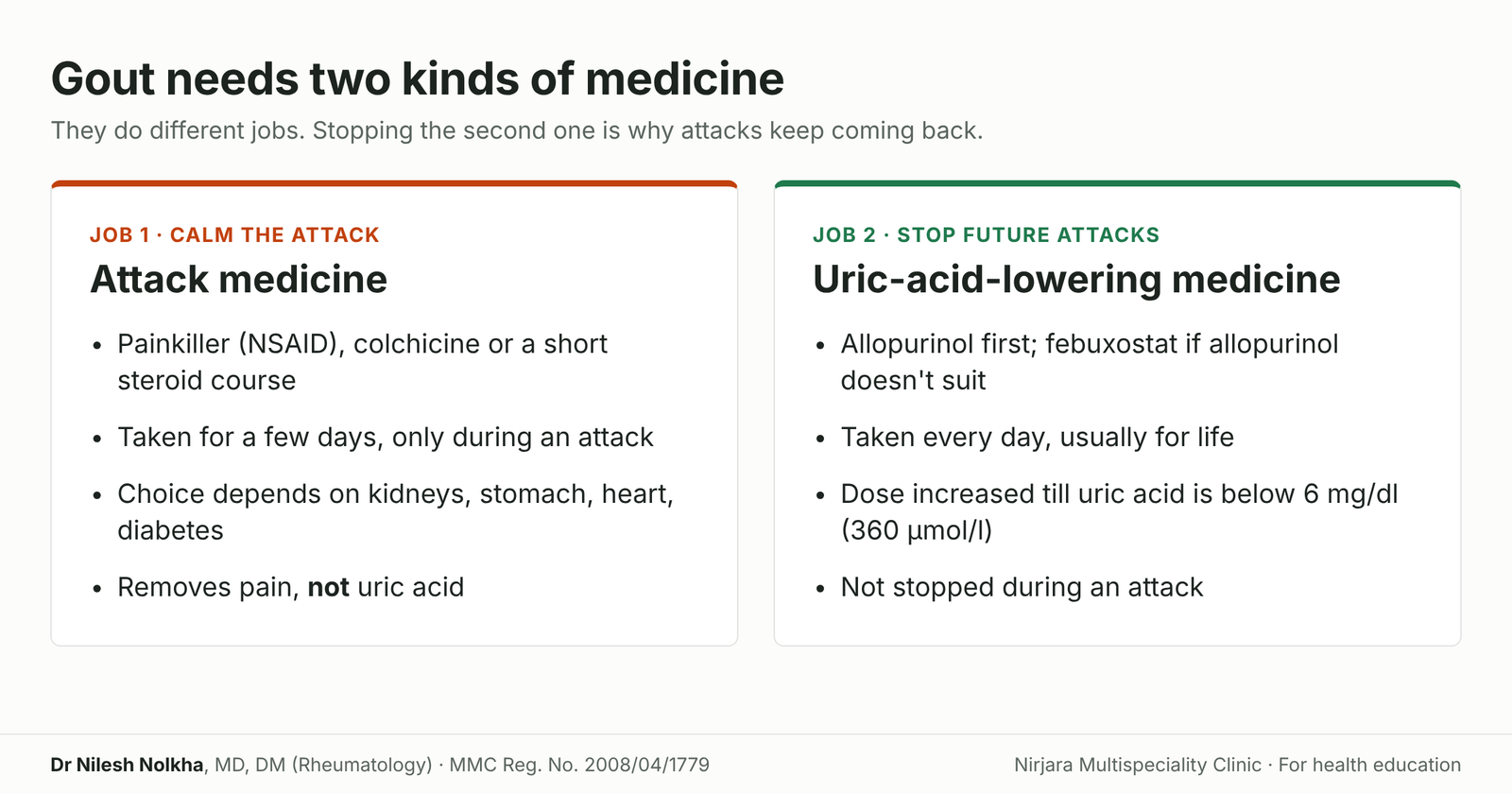
For the attack: a painkiller of the NSAID type, colchicine, or a short course of steroid. Which one suits you depends on your kidneys, stomach, heart and diabetes. Agree on this with your doctor in advance, so you can start it as soon as an attack begins.
To prevent attacks: allopurinol is the first choice. Febuxostat is an alternative when allopurinol doesn’t suit. The target is uric acid below 6 mg/dl (360 µmol/l), and below 5 mg/dl (300 µmol/l) if you have tophi or severe gout.
What to expect:
- The first few months can bring more attacks, not fewer. As uric acid falls, old crystals start dissolving and can trigger attacks. This is a sign the medicine is working, not failing. Your doctor will usually add a low-dose anti-inflammatory medicine, such as colchicine, for the first 3 to 6 months to cover this.
- Don't stop allopurinol during an attack. Continue it, and treat the attack separately.
- Attacks reduce over months. For many people it takes a year or more for the crystals to clear. People with tophi take longer.
- It is usually lifelong. Like blood pressure tablets, it works only while you take it.
Side effects, stated plainly:
- Allopurinol: most people take it for years without trouble. Rarely, it causes a serious skin reaction, usually in the first few months. If you get a rash, mouth ulcers or fever after starting it, stop it and contact your doctor the same day. Kidney function decides the dose.
- Febuxostat: doctors are cautious about using it in people with heart disease. Tell your doctor about any heart problem.
- Colchicine: can cause loose motions at higher doses, and interacts with some common medicines. Don't take extra on your own.
- Blood tests (uric acid, kidney and liver function) are needed every few weeks at first, then less often once you are at target.
What can I do at home?
Take the tablet every day, keep junk and sugary drinks low, and have an attack plan ready. You don’t need a miserable diet.
- Take your uric-acid tablet daily, at the same time. Keep a spare strip at home so you never run out.
- Cut down packaged and junk food, colas, sugary drinks and packaged fruit juices.
- Alcohol, especially beer and spirits, raises uric acid. Moderation, not necessarily complete stopping, once your uric acid is at target.
- Meat and seafood in moderation. Dal, vegetables, tomatoes and palak do not need to be stopped.
- Drink enough water, unless your doctor has restricted fluids.
- If you are overweight, gradual weight loss helps lower uric acid.
- Keep your attack medicine at home and know when to start it. Rest the joint and use a cold pack wrapped in a cloth.
Common myths
‘I’ll control it naturally with diet.’
Diet lowers uric acid only a little, and the effect fades. Most people with recurrent gout need medicine.
‘Dal, tomato and palak cause gout.’
In a large study, purine-rich vegetables were not linked to a higher risk of gout. Meat, seafood, alcohol and sugary drinks matter more.
‘Allopurinol damages the kidneys.’
Allopurinol is the first-choice medicine even in people with kidney disease. The dose is adjusted to kidney function.
Example scenario
This is an illustration, not a real patient.
A middle-aged man has had high uric acid for years. He used to get one gout attack a year in his big toe. Each time he took painkillers for three days and uric acid tablets for a few days, then stopped. Over the last year or two, he has had five or six attacks, now also in the ankle and knee, and they last longer. The right next step: confirm that it is gout, start regular uric-acid-lowering medicine, increase the dose step by step until uric acid stays below 6, and cover the first few months with medicine that prevents attacks.
When should I see a doctor?
See a doctor for your first suspected attack, if attacks are becoming frequent, or if you notice lumps near your joints.
- A sudden, painful, swollen joint for the first time. Gout can look like other types of arthritis.
- A hot, swollen joint with fever or feeling unwell. See a doctor the same day, as a joint infection needs to be ruled out.
- More than one attack a year, or attacks getting more frequent or longer.
- Lumps near joints, on fingers, elbows or ears.
- Rash, mouth ulcers or fever after starting allopurinol.
- Kidney stones along with high uric acid.
Frequently asked questions
Can I stop uric acid medicine once I feel fine? (Kya uric acid ki dawai band kar sakte hain?)
Usually not. Feeling fine is the silent phase, and uric acid rises again within weeks of stopping. Most people with recurrent gout need the medicine for life. Discuss any change with your doctor first.
My uric acid was normal during the attack. Can it still be gout?
Yes. Uric acid often drops during an attack. Get it rechecked a few weeks after the attack settles.
Why did my attacks increase after I started allopurinol?
As uric acid falls, old crystals start dissolving and can trigger attacks. This usually settles over a few months. Your doctor can add medicine to prevent these attacks. Don’t stop allopurinol.
Should I stop allopurinol during an attack?
No. Continue it and treat the attack separately with the medicine your doctor has advised.
How long before the attacks stop?
Attacks usually reduce over several months once uric acid stays below 6. For many people it takes a year or more, longer if there are tophi.
I have high uric acid but have never had an attack. Do I need medicine?
Usually not, unless there are other reasons such as kidney stones. Your doctor will decide based on your overall health.
Is gout hereditary? (Kya gout khandani bimari hai?)
Genes play a big part in how your body handles uric acid. Gout often runs in families, which is why lifestyle alone does not explain it.
Takeaway
Gout doesn’t go away when the pain goes away. The attacks are only what you feel; the uric acid building up in between is what decides how the next few years go. Keep uric acid below 6, take the tablet daily even when you feel fine, and get the level checked regularly.
Next step
If your gout attacks are becoming more frequent, see a qualified rheumatologist for a proper assessment.
Related articles:
Clinic information
Nirjara Multispeciality Clinic
- Kandivali West, Mumbai: [address] | [timings] | [phone]
- Vasai West: [address] | [timings] | [phone]
Services: rheumatology consultation, joint injections, diagnostics, physiotherapy, pharmacy, dentistry.
References
- American College of Rheumatology. 2020 Guideline for the Management of Gout. 2020. https://doi.org/10.1002/acr.24180
- EULAR. 2016 updated recommendations for the management of gout. 2017. https://doi.org/10.1136/annrheumdis-2016-209707
- EULAR. 2018 updated recommendations for the diagnosis of gout. 2020. https://doi.org/10.1136/annrheumdis-2019-215315
- Schlesinger N et al. Serum urate during acute gout. 2009. https://doi.org/10.3899/jrheum.080938
- Major TJ et al. Diet-wide contribution to serum urate levels. 2018. https://doi.org/10.1136/bmj.k3951
- Yokose C et al. Weight loss diets and serum urate (DIRECT trial). 2020. https://doi.org/10.2337/dc20-1002
- Vedder D et al. Dietary interventions for gout: a systematic review. 2019. https://doi.org/10.3390/nu11122955
- Choi HK et al. Purine-rich foods, dairy and protein intake, and the risk of gout. 2004. https://doi.org/10.1056/NEJMoa035700
Disclaimer
This article is for general health education. It is not a substitute for a consultation with a qualified doctor.
Drafted with AI assistance and reviewed by Dr Nilesh Nolkha.